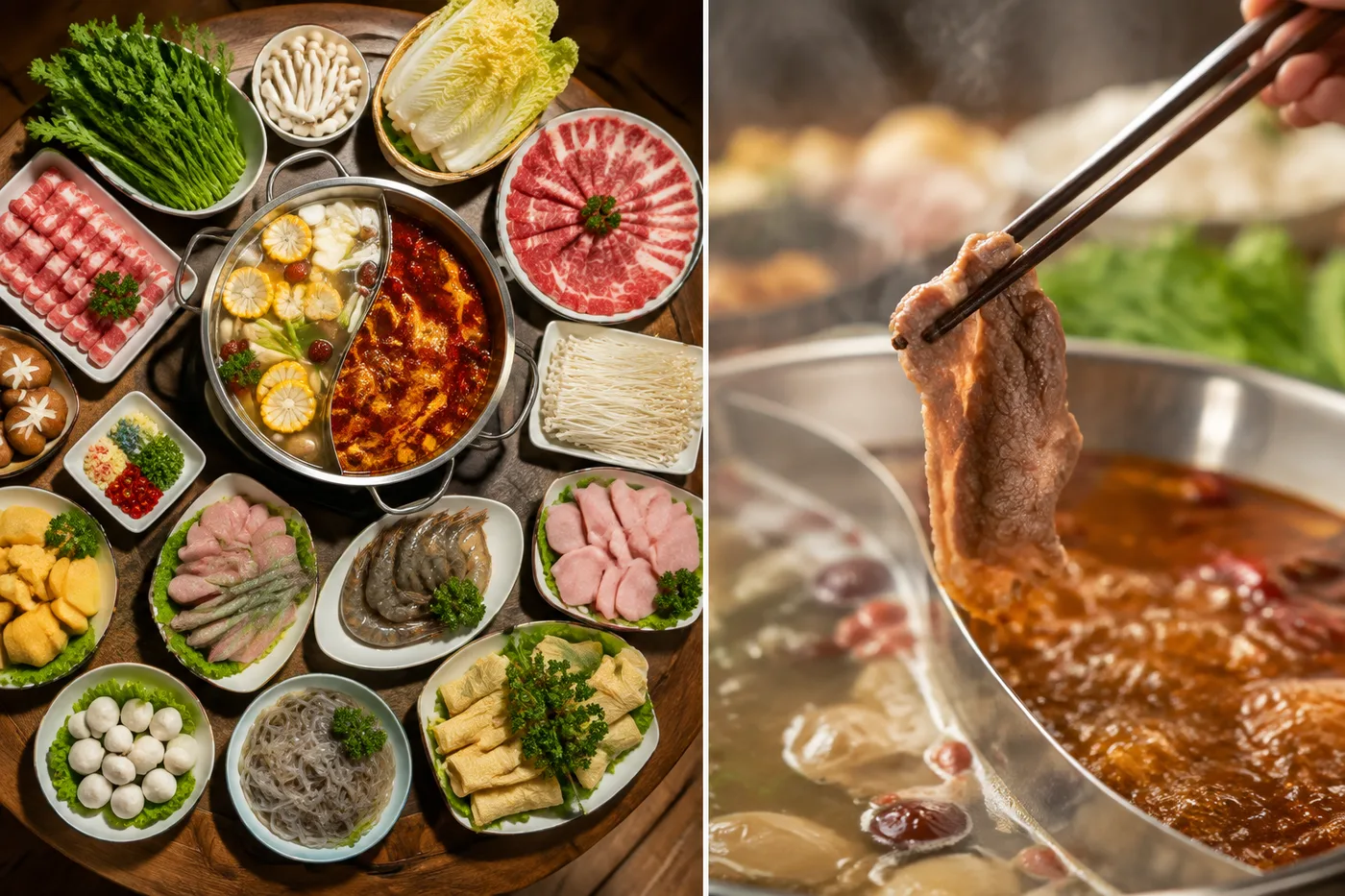
If you have ever looked up mala hot pot and ended up confused about whether you want "Sichuan" or "Chongqing" — you are not alone. Even within China, this debate can start arguments at the dinner table. Both cities claim to be the spiritual home of mala hot pot. Both are right, and both are wrong.
Here is the real breakdown.
The Origin Story
Chongqing hot pot came first. It was born along the Yangtze River docks in the early 20th century, where workers and boatmen simmered cheap offal cuts — tripe, intestine, blood curd — in a pot of heavily spiced broth to mask the smell and make tough cuts edible. The result was fiery, cheap, and addictive.
Sichuan (specifically Chengdu) adopted and refined it. Chengdu restaurants took the raw Chongqing model, dialed back the aggression, added sesame paste dipping sauce, and created a more elegant, restaurant-friendly version. Today most "Sichuan hot pot" you encounter outside China is actually a Chengdu interpretation.
The Broth: Oil, Chilies, and Tallow
Both styles are built on the same foundation: doubanjiang (fermented chili-bean paste, specifically from Pixian county), Sichuan peppercorn, dried chilies, and beef tallow (牛油). But the proportions are different.
Chongqing broth uses more tallow — the broth is visibly oilier and the surface is often covered with a thick layer of red chili oil. Whole dried chilies float in the pot rather than being ground into the base. The result is heavier, more pungent, and more aggressively spiced. Some Chongqing restaurants use blocks of pressed dried chili and spice mixture that dissolve during cooking.
Sichuan/Chengdu broth is more balanced. Less oil on the surface. More aromatic (star anise, cinnamon, bay leaf, black cardamom are more prominent). The numbing from Sichuan peppercorn is present but not overwhelming. The broth is darker in color but somehow feels lighter.
One local saying captures it well: "Chongqing 烫嘴 (burns your mouth), Chengdu 麻嘴 (numbs your mouth)."
The Dipping Sauce: The Biggest Practical Difference
This is where the two styles diverge most visibly, and it is the first thing you will notice at the table.
Chongqing style: Pure sesame oil (香油) in a small bowl, with minced garlic and optionally a little green onion. That is it. No sesame paste. The minimalism is deliberate — the broth is so intensely flavored that the sauce should not compete, just provide an oily buffer for the palate.
Chengdu/Sichuan style: Sesame paste (麻酱) — not peanut butter, pure sesame — thinned with warm water or a ladle of broth to a pourable consistency. Mixed with minced garlic, soy sauce, oyster sauce, fermented tofu (腐乳), chili oil, and sometimes a raw egg yolk. The sauce is complex, nutty, and rich. Building your own sauce from the condiment station is part of the Chengdu hot pot ritual.
If you sit down at a hot pot restaurant and they give you sesame paste, you are in a Chengdu-influenced spot. If they give you just sesame oil, you are closer to Chongqing style.
Key Ingredients That Differ
The ingredient list overlaps heavily — maodu (毛肚, beef tripe), thin beef slices, duck intestine, tofu skin — but Chongqing has two ingredients that are more culturally central there:
Pork aorta (黄喉, huáng hóu): The aorta of a pig, cut into rings. It has a distinctive honeycomb cross-section and an extreme crunch when cooked correctly (5-8 seconds). It is one of the most popular Chongqing offal cuts and almost unknown in Chengdu-style restaurants outside China.
Beef brain (脑花, nǎo huā): Placed directly in the broth in a small dish and cooked tableside. Creamy, rich, intensely flavored. A Chongqing specialty that challenges even experienced hot pot eaters.
The Restaurant Experience
Equally different.
Chongqing restaurants are loud, informal, and often outdoor. The most famous hot pot street in Chongqing — Jiefangbei and the hillside neighborhoods — features plastic stools, fluorescent lights, cigarette smoke, and broth so red it looks radioactive. Bibs are standard. The server often manages the cooking for you. Locals eat maodu with intense precision.
Chengdu restaurants range from the same casual style to genuinely upscale dining. Chengdu has hot pot restaurants with elegant decor, curated ingredient selections, and tea service. The meal is more social and considered.
One tradition unique to Chongqing: at the end of the meal, locals often ladle the remaining broth — now deeply enriched from hours of cooking — over a bowl of plain rice. This is called 油碟泡饭 in some circles, and it is arguably the best bite of the meal.
Which Should You Choose?
| Factor | Chongqing | Sichuan / Chengdu |
|---|---|---|
| Heat intensity | Higher | Adjustable |
| Oil level | Very high | Medium-high |
| Dipping sauce | Sesame oil only | Sesame paste mix |
| Experience | Raw, informal | Refined, flexible |
| Best for | Offal lovers, heat veterans | Groups, beginners welcome |
If you are outside China trying to find one of these styles: most Chinese hot pot chains (Haidilao, Xiaolongkan, Da Long Yi) serve a Chengdu-influenced style. True Chongqing style is rarer internationally but worth seeking out.
Frequently Asked Questions
Generally yes, though it depends on the restaurant. Chongqing broth tends to use more whole dried chilies and more tallow, creating a heavier, more aggressive heat. Sichuan/Chengdu restaurants more commonly offer spice level options (微辣/中辣/特辣), making them more accommodating for different tolerances.
Because the broth is already so intensely flavored that a complex sauce would compete with it and dull the experience. The sesame oil serves as a cool, neutral buffer that lets the broth's flavor dominate. Adding sesame paste to a Chongqing-style meal is considered a Chengdu habit by Chongqing locals.
Most modern hot pot restaurants outside of China serve a Chengdu-influenced version and do not offer the pure Chongqing experience. In China, some restaurants explicitly label their style. Restaurants offering a 鸳鸯锅 (yin-yang split pot) usually have one mala side that blends both influences.
Chongqing was first. But "authentic" is complicated — Chengdu has refined and spread mala hot pot globally more successfully. Both are genuine regional traditions with centuries of development. The better question is which one matches your taste.
Ready to try either style at home?