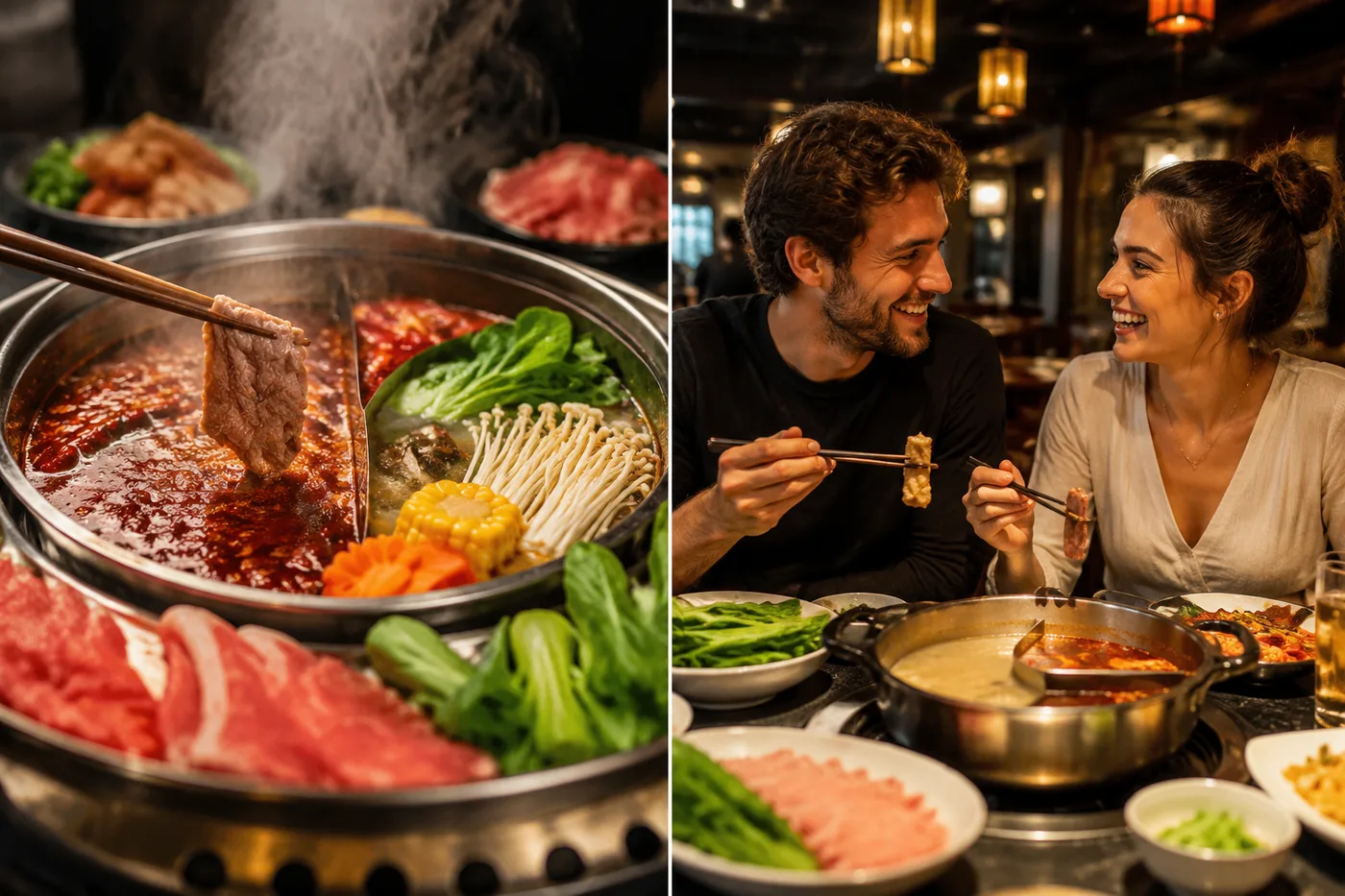
If you have ever sat at a Sichuan hot pot table and watched someone methodically dip what looks like a small piece of pale, textured honeycomb into the broth exactly seven times — that is maodu. And that person knows what they are doing.
Maodu (毛肚, máo dù) is beef tripe — specifically the rumen, the first and largest of a cow's four stomachs. It is the single most ordered ingredient at Sichuan and Chongqing hot pot restaurants, the benchmark by which locals judge whether a restaurant knows what it is doing, and probably the most misunderstood hot pot ingredient for international diners.
What Does Maodu Taste Like?
Honest answer: mild, almost neutral. The flavor of maodu itself is faint — a very slight mineral quality, nothing strong. What makes maodu exceptional is its texture.
When cooked correctly, maodu has an extraordinary crunch — firm but yielding, with a satisfying snap when you bite through it. It is unlike any other food texture. When overcooked, it becomes rubbery and chewy in the wrong way, which is why timing is everything.
Because maodu has almost no flavor of its own, it acts as a perfect vehicle for the mala broth and dipping sauce. Each bite is essentially a delivery mechanism for the broth — which is exactly why it is so popular.
The 七上八下 (Seven-Up, Eight-Down) Technique
This is the most famous piece of hot pot knowledge in China, and it applies specifically to maodu. The Chinese phrase is 七上八下 (qī shàng bā xià) — "seven up, eight down" — referring to how you should move the tripe in the broth.
Hold a piece of maodu with chopsticks and dip it in and out of the boiling broth in a rhythmic motion — seven dips (some say 7, some say 7-8 seconds total). The constant motion ensures even, fast cooking throughout the piece without letting it sit and overcook.
The goal is to cook the maodu until it just begins to curl and tighten — this is the moment of maximum crunch. Remove it immediately. The window between "perfectly crunchy" and "rubbery and overcooked" is about 3-4 seconds. This is why experienced hot pot eaters never take their eyes off their maodu.
Fresh vs. Frozen: Does It Matter?
Yes, significantly. There are two forms of maodu you will encounter:
Fresh maodu (鲜毛肚): Delivered to restaurants the same day, beige-grey in color, slightly thicker. More tender, better texture, shorter cooking time (5-7 seconds). Found in higher-end Sichuan and Chongqing restaurants. If the menu lists it separately at a premium price, it is fresh.
Processed/frozen maodu: Pre-treated with alkaline solution (碱水) which whitens the tripe, softens the texture, and extends shelf life. This is what most mid-range restaurants serve. Still good — just slightly less crunchy than fresh. Cook for 8-10 seconds.
The telltale sign: bright white, very uniform-looking tripe has usually been processed. Naturally-colored beige-grey tripe is more likely fresh. In Chongqing, asking for 鲜毛肚 (fresh maodu) will get you a knowing nod from the server.
Where Is It on the Menu?
At most Sichuan hot pot restaurants, maodu appears prominently near the top of the meat/offal section. It is often listed simply as 毛肚 (máo dù). Portions typically come as a plate of pre-cut pieces, ready to go straight into the pot.
Common alternative names on English-translated menus: "beef tripe," "beef stomach," "honeycomb tripe." All are maodu.
Price range in China: ¥30–80 per plate depending on whether it is fresh or processed. Outside China, expect to find it at Chinese supermarkets frozen, or at Sichuan hot pot restaurants.
How to Eat Maodu: Step by Step
- Pick up one piece with chopsticks (not multiple — they need individual attention)
- With your broth at a full rolling boil, submerge the maodu
- Move it in and out rhythmically 7-8 times over about 7-8 seconds
- Remove as soon as it tightens and curls at the edges
- Dip immediately in your sauce — sesame paste or sesame oil
- Eat immediately. Do not let it sit — it continues cooking from residual heat
Common mistake: Leaving maodu in the pot while you attend to other ingredients. Even 20 extra seconds will ruin the texture. This is why Chongqing locals treat their maodu like a precision operation.
What If You Do Not Like Offal?
Maodu has an unfair reputation as an "offal" ingredient. In practice, it has almost no offal flavor when properly prepared. The beige-grey color when raw is the most alarming thing about it. If you have ever refused it at a hot pot table, try a single piece cooked correctly — you may be surprised. Most converts are made in exactly this way.
That said, the texture is genuinely unusual. If you find extreme crunch off-putting, maodu is not for you regardless of flavor. In that case, try duck intestine (鸭肠) instead — similar cultural status, even more extreme texture, cooked for only 5 seconds.
Frequently Asked Questions
Yes. Maodu served at hot pot restaurants has been cleaned and prepared for consumption. When cooked in boiling broth for the correct time, it reaches safe internal temperature. The preparation and cleaning process for tripe is extensive — what arrives at your table is ready to cook.
Yes — Chinese and Asian supermarkets in most major cities stock frozen pre-processed maodu (often labeled "beef tripe" or "honeycomb tripe"). It is also commonly available at Korean and Vietnamese grocery stores. Online Asian food retailers ship it frozen. Quality varies; look for brands that list the processing method.
Almost always caused by overcooking. The texture window for maodu is very narrow — 7-10 seconds at a full boil. If your broth is not at a full rolling boil, the cooking is uneven and you instinctively leave it in longer, which overcooks it. Bring your broth to a hard boil before adding maodu, and pull it out the moment you see it begin to curl.
Maodu specifically refers to beef rumen (first stomach). It has a distinctive rough, nubby texture on one side. "Honeycomb tripe" (reticulum, second stomach) has a different cross-hatch pattern and slightly different texture. Both are used in hot pot. In Chinese restaurants, 毛肚 means rumen specifically — it is not interchangeable with other stomach types.
Cook maodu tonight: